
Pelaxe Índice Composición | Mamíferos sen pelo | Uso para vestir | Notas | Véxase tamén | Menú de navegaciónDicionario da Real Academia GalegaPortal das PalabrasDicionario da Real Academia GalegaPortal das PalabrasDicionario da Real Academia GalegaPortal das Palabras"Cheiromeles torquatus"1121490510.1007/s004390000439"Molecular evolution of HR, a gene that regulates the postnatal cycle of the hair follicle"Humane Society International Fur Trade"Fur production, by province and territory"The fur industry300011811ID4173641-2fur00565294

Anatomía dos mamíferos


pelosmamíferospeleteiraratas toupa espidascans sen pelocetáceosPrehistoriadocodontosHaramiyidaeutriconodontoscetáceoshipopótamofocaselefanterinocerontepseudoxenequeratinagato esfinxehomínidoshome de Neanderthalveludorapososcoellosvisónscastoresarmiñolontrasmartas cibelinasfocascoioteschinchillasmapachespóssumscoirolafeltrodereitos dos animais


Pelaxe


Na Galipedia, a Wikipedia en galego.


Saltar ata a navegación
Saltar á procura
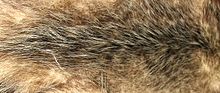


Pelaxe dun didélfido.


A pelaxe[1] é a calidadade ou características dos pelos dos animais mamíferos. O pelame[2] é o conxunto de pelos que nacen da pel dos animais mamíferos, especialmente a daqueles que teñen unha extensa cobertura de pelos. Cando as pelaxes dos animais son procesadas na industria peleteira para convertelas en abrigos e outros complementos para vestir conservando o seu pelo denomínase xeralmente peles[3]. As máis apreciadas son as de pelos suaves e mestos, en oposición aos pelames de pelos escasos e duros de animais como os porcos, que non se utilizan. As pelaxes poden constar de capas diferenciadas de pelos. Os mamíferos con cantidades reducidas de pelo denomínanse ás veces "espidos" ou sen pelo, como as ratas toupa espidas, os cans sen pelo, cetáceos ou en boa medida o ser humano.


Os animais con pelaxes comercialmente valiosas son importantes para a industria peleteira, polo que son cazados ou criados. Os seres humanos utilizaron as peles de animais desde a Prehistoria para abrigarse. Porén, actualmente, o uso de peles para vestir ou decorar considérase polémico por parte dun sector da poboación que está en contra da caza ou da crianza de animais para usar a súa pelaxe con ese fin, xa que considera que non é moralmente aceptable.


Índice


  • 1 Composición


  • 2 Mamíferos sen pelo

    • 2.1 Selección natural


    • 2.2 Selección artificial


  • 3 Uso para vestir

    • 3.1 Controversia


  • 4 Notas


  • 5 Véxase tamén

    • 5.1 Outros artigos


    • 5.2 Ligazóns externas


Composición |


Tipos de pelo que forman o pelame dun gato doméstico.


O pelame dos animais xeralmente consta de dúas capas principais de pelo con distintas características, que son:


  • Pelos da capa inferior de tipo peluxe. A capa inferior consta de pelos lanosos, xeralmente ondulados ou rizados sen porcións rectas nin puntas bicudas; adoitan ser pelos curtos, planos, rizados e máis numerosos que os da capa superior. A súa principal función é a termorregulación; manteñen unha capa de aire seco a rentes da pel e repelen a auga, o que proporciona o illamento térmico.

  • Pelos da capa superior ou de cobertura. A capa superior consta de pelos máis longos, xeralmente máis bastos, con talos case rectos, que fan protrusión entre os pelos da capa inferior. Os extremos distais destes pelos orixinan a capa visible externamente do pelame da maioría dos animais con pelame ben desenvolvido. Esta capa mostra a pigmentación e brillo máis marcado, incluíndo os patróns de debuxo e coloración adaptados para a exhibición ou a camuflaxe. Tamén está adaptada a protexer da auga e bloquear a luz solar, protexendo así a capa inferior e a pel de factores externos como a chuvia e a luz ultravioleta. Moitos animais, como os gatos domésticos, poden ourizar os pelos desta capa como parte da súa exhibición de ameaza cando son inquietados.

Os mamíferos con capas inferior e superior de pelo ben desenvolvidas tamén adoitan ter un gran número de pelos intermedios. Estes empezan o seu crecemento de forma similar aos pelos típicos da capa superior, pero cambian o seu modo de crcemento, xeralmente cando emerxeu menos da metade da lonxitude do pelo. O resto do crecemento é formando un pelo delgado e ondulado, similar ao pelo da capa inferior. En moitas especies de mamíferos, estes pelos comprenden a maior parte do seu pelame visible. A parte proximal destes pelos ten a mesma función que os pelos da capa inferior, mentres que a parte distal achega a función de protección contra a auga que teñen os pelos a capa superior, aínda que a súa porción basal delgada impide que poidan ser ourizados como os verdadeiros pelos da capa superior.
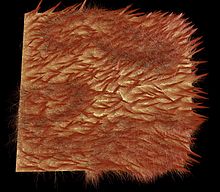


Pelame de auga xerada por computador.


As características modernas da pelaxe dos mamíferos crese que apareceron cos docodontos, Haramiyida e eutriconodontos, e os fósiles de Castorocauda, Megaconus e Spinolestes conservaron folículos compostos con pelos das dúas capas.


Mamíferos sen pelo |


O pelo é unha das características definitorias dos mamíferos, pero varios grupos, especies ou razas teñen unha cantidade de pelo considerablemente reducida ou case ausente, polo que se denominan "espidos" ou "sen pelo".


Selección natural |


Algúns mamíferos reduciron de forma natural a súa cantidade de pelo. Algúns mamíferos acuáticos ou semiacuáticos como os cetáceos ou hipopótamo ou certas especies de focas evolucionaron cara a unha pel espida, presumiblemente para reducir a resistencia á auga. A rata-toupa espida (Heterocephalus glaber) tamén perdeu o pelo, quizais como unha adaptación ao seu estilo de vida subterráneo. Dous dos grandes mamíferos existentes, o elefante e o rinoceronte, teñen moi poucos pelos. O morcego espido (Cheiromeles torquatus) case non ten pelos pero teñen curtos pelos bastos arredor do pescozo, nas súas dedas frontais, e arredor do saco da súa gorxa, xunto con pelos finos na cabeza e membrana da cola. A maioría dos animais sen pelo non poden estar ao sol durante moito tempo ou permaneceren en zonas frías por tempo prolongado.[4]


Os seres humanos son a única especie de primates que evolucionaron experimentando unha significativa perda de pelo corporal. Isto pode deberse á perda da funcionalidade do pseudoxene KRTHAP1 (que axuda a producir queratina) na liñaxe humana hai uns 240.000 anos.[5] As mutacións no xene HR poden orixinar unha completa perda de pelo, aíndo que isto non é o típico nos humanos.[6]


Selección artificial |


Os humanos seleccionaron artrificialmente algunhas especies de animais domesticados para orixinar razas espidas. Hai varias razas de gatos espidos, unha das mellos coñecidas é o gato esfinxe. De xeito similar, hai varias razas de cans sen pelo. Outros exemplos de animais sen pelo seleccionados artificialmente son o cobaia sen pelo, o rato espido e a rata sen pelo.


Uso para vestir |


O piloto norteamericano e explorador ártico Carl Eielson, que leva posto un abrigo de pel.


Para o seu uso para vestir, as peles son normalmente coiro que conserva o seu pelo de especies que teñen unha pelaxe moi estética ou que ten propiedades de illamento. As peles servíronlle de vestido a varios homínidos, como o home de Neanderthal. As peles de animais usadas como adornos e tapicerías poden ser tinguidas con diversas cores ou imitar os debuxos de animais exóticos ou recortadas para imitar a sensación dun tecido de suave veludo.


Entre as fontes animais usuais para accesorios para vestir ou para tapicería están os raposos, coellos, visóns, castores, armiño, lontras, martas cibelinas, focas, coiotes, chinchillas, mapaches, e póssums.


A fabricación de peles para vestir implica conservar os pelos nas peles procesadas, mentres que na fabricación de coiro se elimina o pelo da pel, que despois se curte. O uso de la implica cortar o pelo do animal vivo, que despois lle volve a crecer, polo que non se usa a pel senó só o pelo.[7]


As peles tamén se usan para facer feltro. Por exemplo, un feltro de gran calidade é o que se obtén do castor e se usa en norteamértica para facer sombreiro de vaqueiro de gran calidade.[8]


Controversia |
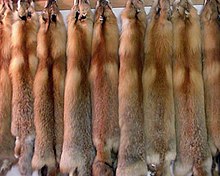


Peles de raposo Vulpes vulpes.


A maioría dos activistas pro dereitos dos animais opóñense ao trampeo ou caza de animais salvaxes e ao confinamento e matanza de animais en granxas para obter as súas peles. Segundo a Humane Society International, cada ano atrápanse na natureza uns 8 millóns de animais para obter a súa pel, mentres que se crían máis de 30 millóns en granxas peleteiras.[9]


Por exemplo, segundo Statistics Canada, en 2010 matáronse 2,6 millóns de animais de peletería criados en granxas. Outros 700.000 morreron en trampas colocadas en ambientes silvestres.[10][11]


Notas |


  1. ↑ Definicións no Dicionario da Real Academia Galega e no Portal das Palabras para Pelaxe.


  2. ↑ Definicións no Dicionario da Real Academia Galega e no Portal das Palabras para Pelame.


  3. ↑ Definicións no Dicionario da Real Academia Galega e no Portal das Palabras para Pel.


  4. ↑ Thomson, Paul (2002). "Cheiromeles torquatus". Animal Diversity Web. Consultado o 29 October 2013. 


  5. ↑ Winter, H.; Langbein, L.; Krawczak, M.; Cooper, D. N.; Jave-Suarez, L. F.; Rogers, M. A.; Praetzel, S.; Heidt, P. J.; Schweizer, J. (2001). "Human type I hair keratin pseudogene phihHaA has functional orthologs in the chimpanzee and gorilla: Evidence for recent inactivation of the human gene after the Pan-Homo divergence". Human Genetics 108 (1): 37–42. PMID 11214905. doi:10.1007/s004390000439. 


  6. ↑ "Molecular evolution of HR, a gene that regulates the postnatal cycle of the hair follicle". Consultado o 2012-03-13. 


  7. ↑ Australian Wool Corporation, Australian Wool Classing, Raw Wool Services, 1990.


  8. ↑ Chamber's journal, Published by Orr and Smith, 1952, pg 200, Original from the University of Michigan.


  9. ↑ Humane Society International Fur Trade.


  10. ↑ "Fur production, by province and territory".


  11. ↑ The fur industry. Peta, n.d.


Véxase tamén |


Outros artigos |


  • Coloración animal

  • Cor do pelo

  • Plumaxe


Ligazóns externas |


Traído desde "https://gl.wikipedia.org/w/index.php?title=Pelaxe&oldid=4985482"


Menú de navegación


(window.RLQ=window.RLQ||[]).push(function()mw.config.set("wgPageParseReport":"limitreport":"cputime":"0.284","walltime":"0.403","ppvisitednodes":"value":598,"limit":1000000,"ppgeneratednodes":"value":0,"limit":1500000,"postexpandincludesize":"value":12461,"limit":2097152,"templateargumentsize":"value":220,"limit":2097152,"expansiondepth":"value":9,"limit":40,"expensivefunctioncount":"value":5,"limit":500,"unstrip-depth":"value":0,"limit":20,"unstrip-size":"value":7964,"limit":5000000,"entityaccesscount":"value":6,"limit":400,"timingprofile":["100.00% 306.225 1 -total"," 68.15% 208.680 1 Modelo:Control_de_autoridades"," 25.87% 79.212 1 Modelo:Listaref"," 17.26% 52.869 2 Modelo:Cita_web"," 5.93% 18.154 1 Modelo:Commons"," 5.15% 15.778 1 Modelo:Irmáns"," 4.15% 12.696 1 Modelo:Caixa_lateral"," 2.39% 7.308 1 Modelo:Cita_publicación_periódica"," 1.79% 5.480 1 Modelo:Título_sen_retrouso"," 1.46% 4.466 3 Modelo:DRAG"],"scribunto":"limitreport-timeusage":"value":"0.159","limit":"10.000","limitreport-memusage":"value":3544276,"limit":52428800,"cachereport":"origin":"mw1319","timestamp":"20190410032825","ttl":2592000,"transientcontent":false);mw.config.set("wgBackendResponseTime":118,"wgHostname":"mw1253"););

Popular posts from this blog

Is it wise to focus on putting odd beats on left when playing double bass drums?What does the tie across other different notes mean?How to improve right hand picking/strumming technique for electric and acoustic guitar?How fast is the BPM should you start to use double bass pedal?Alternative or more advanced methods for counting rhythmsLost direction in practicing drumsIs there any way at all to tell if these measures are 6/4 vs. 3/2?Why is alberti bass so tiring?How does 'meter' differ from 'rhythm' in music?Rhythm question about piano sheet notationWhy is Bach's Cello Suite 1 written in 16th notes

map list to bin numbersquantilization (if that is a word)Map efficiently over duplicates in listGenerating a list of cubefree numbersIs there an equivalent to MATLAB's linspace?Convert a list of hexadecimal numbers to decimalTaking one list Mod a second listlist of items and group of alternative itemsHow find numbers in this list of inequalities?Selecting list entries with a True False index list of similar lengthReplace element in array by checking condition in another listAttempting to fill a table with the number of elements in each bin and make a table with the elements in the bins?

History of India Contents Prehistoric era (until c. 3300 BCE) Bronze Age – "First urbanisation" (c. 3300 – c. 1800 BCE) Climate change, de-urbanisation, and Indo-Aryan migrations (c.1800 – 1500 BCE) Iron Age - Vedic period (c. 1500 – c. 600 BCE) "Second urbanisation" (c. 600 – c. 200 BCE) Classical to early medieval periods (c. 200 BCE – c. 1200 CE) Late medieval period (c. 1200 – 1526 CE) Early modern period (c. 1526–1858 CE) Modern period and independence (after c. 1850 CE) Historiography See also References Further reading External links Navigation menureviewedee[update]The crisisThe Evolution and History of Human Populations in South Asia: Inter-disciplinary Studies in Archaeology, Biological Anthropology, Linguistics and GeneticsThe Ancient Indus: Urbanism, Economy, and Society"Indus River Valley Civilizations"The Ancient Indus: Urbanism, Economy, and Society"India before the British: The Mughal Empire and its Rivals, 1526–1857"Why Europe Grew Rich and Asia Did Not: Global Economic Divergence, 1600–1850Development Centre Studies The World Economy Historical Statistics: Historical StatisticsDeveloping cultures: case studiesEthnic Groups of South Asia and the Pacific: An Encyclopedia: An Encyclopedia"Indian Economy During British Rule""Economic Impact of the British Rule in India | Indian History"The Bone Readers: Science and Politics in Human Origins Research"Out of Africa: new hypotheses and evidence for the dispersal of Homo sapiens along the Indian Ocean rim"10.3109/0301446100363924920334598"Genetic and archaeological perspectives on the initial modern human colonization of southern Asia"2013PNAS..11010699M10.1073/pnas.1306043110369678523754394"Edakkal Caves|Places Around in Wayanad"Protecting megaliths to keep history alive The Hindu daily"Archaeologists rock solid behind Edakkal Cave"The Global Prehistory of Human Migration"Indus Valley 2,000 years older than thought"the original"Stepwells -Cosmology of Subterranean Architecture as seen in Adalaj"A History of Ancient and Early medieval India : from the Stone Age to the 12th century"Stone celts in Harappa"the original"Peoples and languages in pre-islamic Indus valley"the original"The Sindhi language"the originalThe Aryan chromosome"Fluvial landscapes of the Harappan Civilization"2012PNAS..109E1688G10.1073/pnas.1112743109338705422645375"Is River Ghaggar, Saraswati? Geochemical Constraints""An Ancient Civilization, Upended by Climate Change""Huge Ancient Civilization's Collapse Explained"2003GeoRL..30.1425S10.1029/2002GL0168222006QSRv...25.1283M10.1016/j.quascirev.2005.10.0122011QuInt.229..140M10.1016/j.quaint.2009.11.012Climate Change and the Course of Global History: A Rough JourneyA History of Ancient and Early Medieval India: From the Stone Age to the 12th CenturyA History of Ancient and Mediaeval India: From the Stone Age to the 12th CenturyAntennae SwordA History of IndiaA History of IndiaAn Introduction to Hinduism"India: The Late 2nd Millennium and the Reemergence of Urbanism"The Coinage of Ancient IndiaA Sanskrit reader: with vocabulary and notesPedigree: the origins of words from nature"Early Sanskritization. Origins and Development of the Kuru State"10.11588/ejvs.1995.4.823The Sanskrit epics, Part 2The City in South AsiaThe UpanishadsAn Introduction to HinduismReligions of the World, Second Edition: A Comprehensive Encyclopedia of Beliefs and PracticesA History of Ancient and Early Medieval India: From the Stone Age to the 12th CenturyEarly India: From the Origins to AD 1300Republics in ancient Indiapp. 83ff"Magadha Empire""Lumbini Development Trust: Restoring the Lumbini Garden"the originalThe great armies of antiquityarchived"The Achaemenid Persian Empire (550–330 B.C.)""East–West Orientation of Historical Empires"1076-156X"Dinner on the Grand Trunk Road"10.2307/32502263250226"Silappathikaram Tamil Literature"the originalManimekalai – English transliteration of Tamil originalIndian Temple Architecture: Form and Transformation : the Karṇāṭa Drāviḍa Tradition, 7th to 13th CenturiesBuddhist ArchitectureA History of India"The World Economy (GDP) : Historical Statistics by Professor Angus Maddison"The World Economy – Volume 1: A Millennial Perspective and Volume 2: Historical Statistics10.2307/32502140004-36483250214A Comprehensive History of India: Volume 2Between the Empires: Society in India, 300 to 400Emergence of Viṣṇu and Śiva Images in India: Numismatic and Sculptural Evidence"Parthian Pair of Earrings"the originalThe Medical Times and Gazette, Volume 1Greatest emporium in the worldThe Cambridge History of Ancient China: From the Origins of Civilization to 221 BCBuddhist Records of the Western WorldArchaeology in Soviet Central AsiaThe Grandeur of Gandhara: The Ancient Buddhist Civilization of the Swat, Peshawar, Kabul and Indus ValleysIndian Sculpture: Circa 500 B.C.-A.D. 700"The History of Pakistan: The Kushans"Gupta Dynasty – MSN Encartathe original"India – Historical Setting – The Classical Age – Gupta and Harsha""Gupta Dynasty, Golden Age Of India"the original"The Age of the Guptas and After"the originalNumber Theory and Its History"Gupta dynasty (Indian dynasty)""Gupta dynasty: empire in 4th century"the original"The Story of India – Photo Gallery"The ASI say499315420"Pallava script"p. 145"CNG: eAuction 329. INDIA, Post-Gupta (Ganges Valley). Vardhanas of Thanesar and Kanauj. Harshavardhana. Circa AD 606–647. AR Drachm (13mm, 2.28 g, 1h)""Harsha""Sthanvishvara (historical region, India)""Harsha (Indian emperor)"Shyama Kumar Chattopadhyaya (2000) The Philosophy of Sankar's Advaita VedantaShankara's IntroductionShankara's Introduction19373677Shankara's IntroductionIs The Buddhist 'No-Self' Doctrine Compatible With Pursuing Nirvana?The Seven Spiritual Laws Of YogaIndia: The Ancient Past. A History of the Indian-Subcontinent from 7000 BC to AD 1200The Kashmir Series: Glimpses of Kashmiri Culture – Vivekananda Kendra, Kanyakumari (p. 57).Al-Hind: Early Medieval India and the Expansion of Islam, 7th–11th CenturiesHistory of GopāchalaLand of Two Rivers: A History of Bengal from the Mahabharata to MujibEuropean Trade and Colonial ConquestA History of IndiaA Comprehensive History Of Ancient India (3 Vol. Set)"The Last Years of Cholas: The decline and fall of a dynasty"the originalFascinating Hindutva: Saffron Politics and Dalit MobilisationGazetteer of the province of OudhAl- Hind: The slave kings and the Islamic conquest. 2"Shahi Family"The Cambridge history of Islam"Ameer Nasir-ood-deen Subooktugeen"Gazetteer of the Attock District, 1930, Part 1Land of seven rivers: History of India's GeographyTemple Desecration and Indo-Muslim StatesIslam in South Asia: A Short HistoryBeyond Orientalism: The Work of Wilhelm Halbfass and Its Impact on Indian and Cross-cultural StudiesThe Making of Terrorism in Pakistan: Historical and Social Roots of ExtremismOrnament in Indian ArchitectureA historical review of Hindu India: 300 B.C. to 1200 A.D."Indian States and Union Territories"Islam in South Asia: A Short HistoryA Brief History of the Indian PeoplesThe Modern ReviewDelhi Sultanate"Battuta's Travels: Delhi, capital of Muslim India"the original"Timur – conquest of India"the originalIndia HandbookBhaktiThe Four Denomination of Hinduism10.1007/s11407-008-9049-925691067"Vijayanagara Research Project::Elephant Stables"10.2307/26465262646526Historical Dictionary of the TamilsBihar General Knowledge DigestMapping Bihar: From Medieval to Modern TimesPopular Literature and Pre-modern Societies in South AsiaA manual of the Kistna district in the presidency of MadrasAncient Indian History and CivilizationFragmented Memories: Struggling to be Tai-Ahom in India"The Islamic World to 1600: Rise of the Great Islamic Empires (The Mughal Empire)"the originalDynasties: A Global History of Power, 1300–1800, p. 105"Whose fort is it anyway"10.1111/0020-8833.000532600793Development Centre Studies The World Economy Historical Statistics: Historical Statistics"India's Deindustrialization in the 18th and 19th Centuries"The Mughal Empire, p. 190"The Long Globalization and Textile Producers in India"The Mughal World: Life in India's Last Golden AgeAurangzeb: The Life and Legacy of India's Most Controversial KingIn the Shadow of the Taj: A Portrait of Agra"Iran in the Age of the Raj"p. 8610.2307/20539802053980Delhi, the Capital of IndiaAn Advanced History of Modern India"Journal of the Tanjore Maharaja Serfoji's Sarasvati Mahal Library"The Rediscovery of India: A New SubcontinentIslamic Renaissance In South Asia (1707–1867) : The Role Of Shah Waliallah & His SuccessorsAn Advanced History of Modern IndiaThe Great Maratha Mahadaji Scindia"Full text of "Selections from the papers of Lord Metcalfe; late governor-general of India, governor of Jamaica, and governor-general of Canada""The Discovery Of IndiaThe Sacred City of the Hindus: An Account of Benares in Ancient and Modern TimesResurrecting Banaras: Urban Space, Architecture and Religious BoundariesFaith & Philosophy of Sikhism"Missiles mainstay of Pak's N-arsenal"History Modern India By S.N. Sen"Sirajuddaula"ArchivedLongman History & Civics (Dual Government in Bengal)Madhya Pradesh National Means-Cum-Merit Scholarship Exam (Warren Hasting's system of Dual Government)A Military History of Britain: from 1775 to the PresentIndian Cultural Heritage Perspective For TourismHindu Rulers, Muslim Subjects: Islam, Rights, and the History of KashmirIndian HistoryAn Atlas and Survey of South Asian HistoryAn Historical Account of the British Trade Over the Caspian SeaIndian Merchants and Eurasian Trade, 1600–1750The Indian diaspora in Central Asia and its trade, 1550–1900From Constantinople to the home of Omar Khayyam: travels in Transcaucasia and northern Persia for historic and literary researchA journey from Bengal to England: through the northern part of India, Kashmire, Afghanistan, and Persia, and into Russia, by the Caspian-SeaA Second Journey through Persia, Armenia, and Asia Minor, to Constantinople, between the Years 1810 and 1816Reports from the consuls of the United States, 1887Portugal and its Empire, 1250–1800 (Collected Essays in Memory of Glenn J. Ames).: Portuguese Studies Review, Vol. 17, No. 1The Dutch Power in Kerala, 1729–1758http://mod.nic.inArchivedDossier Goa – A Recusa do Sacrifício InútilAn Imperial Crisis in British India: The Manipur Uprising of 1891The Truth of Babri Mosque"Kolkata (Calcutta) : History"the original"Robert Clive, Baron Clive, 'Clive of India', 1725–1774""The Transformation from a Pre-Colonial to a Colonial Order: The Case of India"10.2307/25955872595587A versatile geniusArchived10.1109/MWSYM.1997.602854"Rabindranath Tagore on Education"the original"Essay on 'Derozio and the Young Bengal Movement'"Poverty and Famines: An Essay on Entitlement and Deprivation"Plague"the originalPopulation Growth and Land Use"Reintegrating India with the World Economy""Census Of India 1931"A history of modern India, 1480–1950"'India's well-timed diversification of army helped democracy' | Business Standard News"Bal Gangadhar Tilak: Struggle for Swaraj"Participants from the Indian subcontinent in the First World War""Commonwealth War Graves Commission Annual Report 2007–2008 Online"the original1462689197110.1017/s0010417500016534178920Eurocentrism: a marxian critical realist critique"Ranjit Guha, "On Some Aspects of Historiography of Colonial India""10.2307/2168385216838510.7202/016593ar"Harvard scholar says the idea of India dates to a much earlier time than the British or the Mughals""In The Footsteps of Pilgrims""India's spiritual landscape: The heavens and the earth""India: A Sacred Geography by Diana L Eck – review"Modern India: The Origins of an Asian Democracy10.2307/21694222169422964322464"The Indian Subcontinent and 'Out of Africa 1'"254043308Encyclopedia of World ReligionsThe Evolution and History of Human Populations in South Asia: Inter-disciplinary Studies in Archaeology, Biological Anthropology, Linguistics and Genetics"The Early Paleolithic of the Indian Subcontinent: Hominin Colonization, Dispersals and Occupation History"Ancient Indian History and CivilizationAncient Indian Social History: Some Interpretationsthe originalIndia Before EuropeA Concise History of Modern India"The beginning of the historical period, c. 500–150 BCE"full textA History of Indiathe originalexcerpt and text searchexcerptexcerptAn Economic History of India: From Pre-Colonial Times to 1991excerpt and text searchexcerpt and text searchIndia as known to the ancient world10.1111/j.1468-0289.1985.tb00391.x2597191onlineThe History of India, as told by its own historians. The Muhammadan Periodonline editionHans William Brown research collection on 19th-century missionary work in India, 1882–1932, Ms. Coll. 1033, Kislak Center for Special Collections, Rare Books and Manuscripts, University of Pennsylvaniaee