
Myrpiggsvin Innehåll Systematik | Utbredning | Utseende | Ekologi | Myrpiggsvin och människan | Referenser | Navigeringsmenytyskspråkiga WikipediaNordisk familjebok, EchidnaTachyglossidaeonlineTachyglossus aculeatusTachyglossidae168059414323755230892593974210300002

Kloakdjur


kloakdjurAustralienTasmanienNya GuineadäggdjurenutvecklingslinjeevolutionenhårendiarTheriapungdjurhögre däggdjurfossilapliocenkritapleistocenNya GuineaAustralienKortnäbbat myrpiggsvinTasmanienlångnäbbiga myrpiggsvinigelkottarnanäbbdjuretkloaköppningklorgifthabitatökenområdenskogarmyrortermiterinsekterryggradslösa djurbältaäggOlympiska sommarspelen i Sydney


Myrpiggsvin


Från Wikipedia


Hoppa till navigering
Hoppa till sök


.mw-parser-output .infoboxborder:1px solid #aaa;background-color:#f9f9f9;color:black;margin:.5em 0 .5em 1em;padding:.2em;float:right;clear:right;width:22em;text-align:left;font-size:88%;line-height:1.6em.mw-parser-output .infobox td,.mw-parser-output .infobox thvertical-align:top;padding:0 .2em.mw-parser-output .infobox captionfont-size:larger.mw-parser-output .infobox.borderedborder-collapse:collapse.mw-parser-output .infobox.bordered td,.mw-parser-output .infobox.bordered thborder:1px solid #aaa.mw-parser-output .infobox.bordered .borderless td,.mw-parser-output .infobox.bordered .borderless thborder:0.mw-parser-output .infobox-showbutton .mw-collapsible-textcolor:inherit.mw-parser-output .infobox.bordered .mergedtoprow td,.mw-parser-output .infobox.bordered .mergedtoprow thborder:0;border-top:1px solid #aaa;border-right:1px solid #aaa.mw-parser-output .infobox.bordered .mergedrow td,.mw-parser-output .infobox.bordered .mergedrow thborder:0;border-right:1px solid #aaa.mw-parser-output .infobox.geographyborder:1px solid #ccd2d9;text-align:left;border-collapse:collapse;line-height:1.2em;font-size:90%.mw-parser-output .infobox.geography td,.mw-parser-output .infobox.geography thborder-top:solid 1px #ccd2d9;padding:0.4em 0.6em 0.4em 0.6em.mw-parser-output .infobox.geography .mergedtoprow td,.mw-parser-output .infobox.geography .mergedtoprow thborder-top:solid 1px #ccd2d9;padding:0.4em 0.6em 0.2em 0.6em.mw-parser-output .infobox.geography .mergedrow td,.mw-parser-output .infobox.geography .mergedrow thborder:0;padding:0 0.6em 0.2em 0.6em.mw-parser-output .infobox.geography .mergedbottomrow td,.mw-parser-output .infobox.geography .mergedbottomrow thborder-top:0;border-bottom:solid 1px #ccd2d9;padding:0 0.6em 0.4em 0.6em.mw-parser-output .infobox.geography .maptable td,.mw-parser-output .infobox.geography .maptable thborder:0;padding:0


Myrpiggsvin
Long-beakedEchidna.jpg
Myrpiggsvin av släktet Zaglossus.

Systematik
Domän
Eukaryoter
Eukaryota
Rike
Djur
Animalia
Stam
Ryggsträngsdjur
Chordata
Understam
Ryggradsdjur
Vertebrata
Klass
Däggdjur
Mammalia
UnderklassProtheria
Ordning
Kloakdjur
Monotremata
Familj
Myrpiggsvin
Tachyglossidae
Vetenskapligt namn

§ Tachyglossidae
Auktor
Gill, 1872

Släkten och arter


  • Tachyglossus
    • Tachyglossus aculeatus


  • Zaglossus
    • Zaglossus attenboroughi

    • Zaglossus bruijnii

    • Zaglossus bartoni

    • †Zaglossus hacketti

    • †Zaglossus robustus


Hitta fler artiklar om djur med
Djurportalen

Myrpiggsvin eller Echidna (Tachyglossidae) är en familj i ordningen kloakdjur som består av fyra arter fördelade på två släkten som enbart förekommer i Australien, Tasmanien och på Nya Guinea.


Innehåll


  • 1 Systematik


  • 2 Utbredning


  • 3 Utseende

    • 3.1 Kroppsbyggnad och pälsen


    • 3.2 Extremiteter


    • 3.3 Huvud


  • 4 Ekologi


  • 5 Myrpiggsvin och människan


  • 6 Referenser

    • 6.1 Noter


    • 6.2 Tryckta källor


Systematik |


Myrpiggsvin räknas liksom näbbdjuret till däggdjuren, då definitionen av däggdjur inte bygger på deras sätt att föda ungar utan på deras gemensamma utvecklingslinje i evolutionen. Dessutom finns flera kännetecken som myrpiggsvin har gemensamt med andra däggdjur, till exempel håren och att ungarna diar mjölk från sin mor. Trots att de första däggdjuren troligen förökade sig med ägg utgör kloakdjuren inte förfäderna till gruppen Theria (pungdjur och högre däggdjur). Kloakdjuren är snarare en sidogren som har några ursprungliga kännetecken kvar.


Antalet fossila myrpiggsvin är få. De äldsta kända fossilen är kända från pliocen och de var ganska lika dagens myrpiggsvin. Trots allt antas att familjen uppkom under krita. Den största kända arten, Zaglossus hacketti, levde under pleistocen i västra Australien och hade en kroppslängd omkring en meter samt en vikt vid 30 kilogram.


Familjen delas upp i två släkten:[1]


FAMILJ TACHYGLOSSIDAE


  • släkte Tachyglossus - kortnäbbiga myrpiggsvin

    • Kortnäbbat myrpiggsvin (Tachyglossus aculeatus)

  • släkte Zaglossus - långnäbbiga myrpiggsvin
    • Zaglossus attenboroughi

    • Zaglossus bruijni

    • Zaglossus bartoni

    • †Zaglossus hacketti

    • †Zaglossus robustus


Antalet arter är omstritt. Den senaste beskrivna arten, Zaglossus attenboroughi, upptäcktes först 1998 i Nya Guineas högland.


Utbredning |


Myrpiggsvin förekommer på Nya Guinea och Australien. Kortnäbbat myrpiggsvin (Tachyglossus aculeatus) lever på Nya Guinea och Australien samt på öar i närheten som Tasmanien. Släktet långnäbbiga myrpiggsvin (Zaglossus) förekommer bara på Nya Guinea.[2]


Utseende |


Kroppsbyggnad och pälsen |
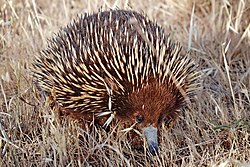


Tachyglossus aculeatus i Victoria, Australien.


Myrpiggsvinen har en långt utdragen, rund, naken nos, lång och smal tunga som liknar en mask och kan sträckas långt utanför munnen, de liksom hos igelkottarna av taggar och hår täckta övre kroppsdelarna och de stora, platta med grävklor försedda tårna. Myrpiggsvinen har också mycket kort svans och korta, tjocka fötter. Taggarna är upp till 60 millimeter långa och har vanligen en gulaktig färg, men deras spets är ofta svart. Ibland är taggarna gömda av de långa håren. Pälsens färg är främst brun- eller svartaktig. Hårens längd är beroende på levnadsområdet, i kalla regioner är de vanligen längre och tätare. Hos långnäbbiga myrpiggsvin är taggarna allmänt kortare och mera glest fördelade. För övrigt påminner den klumpiga kroppen ganska mycket om igelkottens.


Med en kroppslängd mellan 30 och 40 centimeter samt en vikt mellan 2 och 7 kilogram är kortnäbbad myrpiggsvin den minsta arten.[3] De långnäbbiga myrpiggsvinen når en längd mellan 45 och 77 centimeter samt en vikt upp till 16 kilogram. Hannar är vanligen större och tyngre än honor. Den korta svansen är på ovansidan täckt av taggar och på undersidan naken. Liksom hos näbbdjuret har mag- tarmsystemet och könsorganerna en gemensam kloaköppning.


Kroppstemperaturen ligger vanligen mellan 31 och 33 °C, alltså tydligt mindre än hos de flesta andra däggdjuren.


Extremiteter |


Kortnäbbat myrpiggsvin.


Vid varje fot finns fem tår. Hos kortnäbbat myrpiggsvin är alla tår utrustade med klor medan långnäbbiga myrpiggsvin bara har klor vid de mellersta tre tårna. Den andra tån av de bakre extremiteterna är förlängd och används för pälsvårdnaden.[2] Liksom näbbdjuret har flera vuxna hannar vid de bakre fötterna en tagg. Som ungdjur har alla myrpiggsvin denna tagg men honor tappar taggen innan de är könsmogna och även några hannar blir av med taggen. I motsats till näbbdjuret innehåller taggen inget gift. Under parningstiden avsöndra hannarna ett sekret från taggen men vätskans syfte är okänt.


Huvud |


Munnen, som är liten och öppnar sig längst ut på undre sidan av nosspetsen, saknar tänder, men har i gommen tvärrader av små, hårda, spetsiga, bakåt riktade, hornartade taggar. Arternas luktsinne är bra utvecklade. Liksom näbbdjuret kan de känna av elektriska impulser som uppstår vid bytesdjurens rörelse. Myrpiggsvin saknar yttre öron och ögonen är små.


Ekologi |


Fil:French Island Echidna.ogvSpela upp media

Myrpiggsvin som försvarar sig i en grop


Myrpiggsvin anpassar sig till olika habitat. De i ökenområden i Australiens inre samt i skogar och kulturlandskap. På Nya Guinea förekommer de upp till 4000 meter över havet men även nära strandlinjen. Individerna vilar ofta i håligheter under träd eller i bergssprickor och jordgrottor.


Myrpiggsvinen gräver sig hålor och gångar under trädrötterna och håller sig dolda under dagen. Men på natten kommer de fram för att söka sig föda. I sina rörelser är de livliga och verkliga mästare i konsten att gräva. När de gräver visar de både snabbhet och styrka. De lever företrädesvis av myror och termiter som de gräver upp ur deras stackar och fångar med den klibbiga tungan. De äter också andra insekter och andra ryggradslösa djur.[4] Om man försöker ta tag i ett myrpiggsvin rullar det ögonblickligen ihop sig, så att de skarpa taggarna gör det ganska svårt att hålla fast det. Har ett sådant djur väl lyckats få sig en liten grop är det svårt att dra fram det, eftersom det, liksom gördeldjuren (bälta), spärrar ut taggarna och trycker dem hårt mot hålighetens väggar. Myrpiggsvinet ger ibland ifrån sig ett svagt grymtande. Bakfotens sporre hos hannen används inte till försvar, men är kanske under brunsttiden ett vapen som hannarna bekämpar varandra med.


Myrpiggsvinen lägger ägg, som de för in i pungen med hjälp av munnen. Äggen kläcks efter 7 till 10 dagar och ungarna stannar ytterligare 6 till 8 veckor i pungen.[4]


Myrpiggsvin och människan |


År 2000 var ett myrpiggsvin med namnet Millie (tillsammans med två andra Australiensiska djur) maskot för Olympiska sommarspelen i Sydney.


Referenser |


Den här artikeln är helt eller delvis baserad på material från tyskspråkiga Wikipedia, 14 juni 2009.
Small Sketch of Owl.pngDen här artikeln är helt eller delvis baserad på material från Nordisk familjebok, Echidna, 1904–1926.


Noter |


  1. ^ Wilson & Reeder (red.) Mammal Species of the World, 2005, Tachyglossidae

  2. ^ [a b] Nowak, R. M. (1999) sid. 7-12 online


  3. ^ Tachyglossus aculeatus på Animal Diversity Web (engelska), besökt 29 april 2010.

  4. ^ [a b] Tachyglossidae på Animal Diversity Web (engelska), besökt 29 april 2010.


Tryckta källor |


  • Priemé, Anders (2001). ”Australiens okrönte kung myrpiggsvinet har erövrat en hel kontinent”. Illustrerad vetenskap (nr 14): sid. 64-67. 

  • M. L. Augee: Echidnas of Australia and New Guinea. University of New South Wales (UNSW) Press, Kensington 1997, ISBN 0-86840-046-7.


  • Bernhard Grzimek: Grzimeks Tierleben. Bd 10. Säugetiere 1. Bechtermünz, Augsburg 2000, ISBN 3-8289-1603-1.

  • John A. Long. u. a.: Prehistoric Mammals of Australia and New Guinea. Johns Hopkins University Press, Baltimore 2003, ISBN 0-8018-7223-5.

  • Ronald M. Nowak: Walker’s mammals of the world. 6 upplaga. Johns Hopkins University Press, Baltimore 1999, ISBN 0-8018-5789-9.

  • Peggy Rismiller: The Echidna. Australia’s Enigma. Hugh Lauter Levin Associates, 1999, ISBN 0-88363-788-X.


.mw-parser-output table.navboxborder:#aaa 1px solid;width:100%;margin:auto;clear:both;font-size:88%;text-align:center;padding:1px.mw-parser-output table.navbox+table.navboxmargin-top:-1px.mw-parser-output .navbox-title,.mw-parser-output .navbox-abovebelow,.mw-parser-output table.navbox thtext-align:center;padding-left:1em;padding-right:1em.mw-parser-output .navbox-thlinkcolor .navbox-title acolor:inherit.mw-parser-output .nowraplinks a,.mw-parser-output .nowraplinks .selflinkwhite-space:nowrap.mw-parser-output .navbox-groupwhite-space:nowrap;text-align:right;font-weight:bold;padding-left:1em;padding-right:1em.mw-parser-output .navbox,.mw-parser-output .navbox-subgroupbackground:#fdfdfd.mw-parser-output .navbox-listborder-color:#fdfdfd.mw-parser-output .navbox-title,.mw-parser-output table.navbox thbackground:#b0c4de.mw-parser-output .navbox-abovebelow,.mw-parser-output .navbox-group,.mw-parser-output .navbox-subgroup .navbox-titlebackground:#d0e0f5.mw-parser-output .navbox-subgroup .navbox-group,.mw-parser-output .navbox-subgroup .navbox-abovebelowbackground:#deeafa.mw-parser-output .navbox-evenbackground:#f7f7f7.mw-parser-output .navbox-oddbackground:transparent


Hämtad från "https://sv.wikipedia.org/w/index.php?title=Myrpiggsvin&oldid=43145838"


Navigeringsmeny


(window.RLQ=window.RLQ||[]).push(function()mw.config.set("wgPageParseReport":"limitreport":"cputime":"0.592","walltime":"0.709","ppvisitednodes":"value":7201,"limit":1000000,"ppgeneratednodes":"value":0,"limit":1500000,"postexpandincludesize":"value":44895,"limit":2097152,"templateargumentsize":"value":22605,"limit":2097152,"expansiondepth":"value":22,"limit":40,"expensivefunctioncount":"value":7,"limit":500,"unstrip-depth":"value":0,"limit":20,"unstrip-size":"value":6502,"limit":5000000,"entityaccesscount":"value":8,"limit":400,"timingprofile":["100.00% 638.148 1 -total"," 42.37% 270.386 1 Mall:Taxobox"," 41.63% 265.649 1 Mall:Taxonbar"," 40.63% 259.294 1 Mall:Navbox"," 38.61% 246.377 1 Mall:Faktamall"," 34.95% 223.003 1 Mall:Flatlist"," 34.47% 219.940 1 Mall:1x"," 33.14% 211.488 37 Mall:Taxonbar/Link"," 19.87% 126.791 52 Mall:If_empty"," 11.50% 73.387 7 Mall:URL"],"scribunto":"limitreport-timeusage":"value":"0.129","limit":"10.000","limitreport-memusage":"value":3379607,"limit":52428800,"cachereport":"origin":"mw1325","timestamp":"20190405102021","ttl":2592000,"transientcontent":false););"@context":"https://schema.org","@type":"Article","name":"Myrpiggsvin","url":"https://sv.wikipedia.org/wiki/Myrpiggsvin","sameAs":"http://www.wikidata.org/entity/Q21824","mainEntity":"http://www.wikidata.org/entity/Q21824","author":"@type":"Organization","name":"Bidragsgivare till Wikimedia-projekten","publisher":"@type":"Organization","name":"Wikimedia Foundation, Inc.","logo":"@type":"ImageObject","url":"https://www.wikimedia.org/static/images/wmf-hor-googpub.png","datePublished":"2005-05-21T22:29:30Z","dateModified":"2018-06-17T14:35:00Z","image":"https://upload.wikimedia.org/wikipedia/commons/3/3b/Long-beakedEchidna.jpg"(window.RLQ=window.RLQ||[]).push(function()mw.config.set("wgBackendResponseTime":159,"wgHostname":"mw1247"););

Popular posts from this blog

Is it wise to focus on putting odd beats on left when playing double bass drums?What does the tie across other different notes mean?How to improve right hand picking/strumming technique for electric and acoustic guitar?How fast is the BPM should you start to use double bass pedal?Alternative or more advanced methods for counting rhythmsLost direction in practicing drumsIs there any way at all to tell if these measures are 6/4 vs. 3/2?Why is alberti bass so tiring?How does 'meter' differ from 'rhythm' in music?Rhythm question about piano sheet notationWhy is Bach's Cello Suite 1 written in 16th notes

History of India Contents Prehistoric era (until c. 3300 BCE) Bronze Age – "First urbanisation" (c. 3300 – c. 1800 BCE) Climate change, de-urbanisation, and Indo-Aryan migrations (c.1800 – 1500 BCE) Iron Age - Vedic period (c. 1500 – c. 600 BCE) "Second urbanisation" (c. 600 – c. 200 BCE) Classical to early medieval periods (c. 200 BCE – c. 1200 CE) Late medieval period (c. 1200 – 1526 CE) Early modern period (c. 1526–1858 CE) Modern period and independence (after c. 1850 CE) Historiography See also References Further reading External links Navigation menureviewedee[update]The crisisThe Evolution and History of Human Populations in South Asia: Inter-disciplinary Studies in Archaeology, Biological Anthropology, Linguistics and GeneticsThe Ancient Indus: Urbanism, Economy, and Society"Indus River Valley Civilizations"The Ancient Indus: Urbanism, Economy, and Society"India before the British: The Mughal Empire and its Rivals, 1526–1857"Why Europe Grew Rich and Asia Did Not: Global Economic Divergence, 1600–1850Development Centre Studies The World Economy Historical Statistics: Historical StatisticsDeveloping cultures: case studiesEthnic Groups of South Asia and the Pacific: An Encyclopedia: An Encyclopedia"Indian Economy During British Rule""Economic Impact of the British Rule in India | Indian History"The Bone Readers: Science and Politics in Human Origins Research"Out of Africa: new hypotheses and evidence for the dispersal of Homo sapiens along the Indian Ocean rim"10.3109/0301446100363924920334598"Genetic and archaeological perspectives on the initial modern human colonization of southern Asia"2013PNAS..11010699M10.1073/pnas.1306043110369678523754394"Edakkal Caves|Places Around in Wayanad"Protecting megaliths to keep history alive The Hindu daily"Archaeologists rock solid behind Edakkal Cave"The Global Prehistory of Human Migration"Indus Valley 2,000 years older than thought"the original"Stepwells -Cosmology of Subterranean Architecture as seen in Adalaj"A History of Ancient and Early medieval India : from the Stone Age to the 12th century"Stone celts in Harappa"the original"Peoples and languages in pre-islamic Indus valley"the original"The Sindhi language"the originalThe Aryan chromosome"Fluvial landscapes of the Harappan Civilization"2012PNAS..109E1688G10.1073/pnas.1112743109338705422645375"Is River Ghaggar, Saraswati? Geochemical Constraints""An Ancient Civilization, Upended by Climate Change""Huge Ancient Civilization's Collapse Explained"2003GeoRL..30.1425S10.1029/2002GL0168222006QSRv...25.1283M10.1016/j.quascirev.2005.10.0122011QuInt.229..140M10.1016/j.quaint.2009.11.012Climate Change and the Course of Global History: A Rough JourneyA History of Ancient and Early Medieval India: From the Stone Age to the 12th CenturyA History of Ancient and Mediaeval India: From the Stone Age to the 12th CenturyAntennae SwordA History of IndiaA History of IndiaAn Introduction to Hinduism"India: The Late 2nd Millennium and the Reemergence of Urbanism"The Coinage of Ancient IndiaA Sanskrit reader: with vocabulary and notesPedigree: the origins of words from nature"Early Sanskritization. Origins and Development of the Kuru State"10.11588/ejvs.1995.4.823The Sanskrit epics, Part 2The City in South AsiaThe UpanishadsAn Introduction to HinduismReligions of the World, Second Edition: A Comprehensive Encyclopedia of Beliefs and PracticesA History of Ancient and Early Medieval India: From the Stone Age to the 12th CenturyEarly India: From the Origins to AD 1300Republics in ancient Indiapp. 83ff"Magadha Empire""Lumbini Development Trust: Restoring the Lumbini Garden"the originalThe great armies of antiquityarchived"The Achaemenid Persian Empire (550–330 B.C.)""East–West Orientation of Historical Empires"1076-156X"Dinner on the Grand Trunk Road"10.2307/32502263250226"Silappathikaram Tamil Literature"the originalManimekalai – English transliteration of Tamil originalIndian Temple Architecture: Form and Transformation : the Karṇāṭa Drāviḍa Tradition, 7th to 13th CenturiesBuddhist ArchitectureA History of India"The World Economy (GDP) : Historical Statistics by Professor Angus Maddison"The World Economy – Volume 1: A Millennial Perspective and Volume 2: Historical Statistics10.2307/32502140004-36483250214A Comprehensive History of India: Volume 2Between the Empires: Society in India, 300 to 400Emergence of Viṣṇu and Śiva Images in India: Numismatic and Sculptural Evidence"Parthian Pair of Earrings"the originalThe Medical Times and Gazette, Volume 1Greatest emporium in the worldThe Cambridge History of Ancient China: From the Origins of Civilization to 221 BCBuddhist Records of the Western WorldArchaeology in Soviet Central AsiaThe Grandeur of Gandhara: The Ancient Buddhist Civilization of the Swat, Peshawar, Kabul and Indus ValleysIndian Sculpture: Circa 500 B.C.-A.D. 700"The History of Pakistan: The Kushans"Gupta Dynasty – MSN Encartathe original"India – Historical Setting – The Classical Age – Gupta and Harsha""Gupta Dynasty, Golden Age Of India"the original"The Age of the Guptas and After"the originalNumber Theory and Its History"Gupta dynasty (Indian dynasty)""Gupta dynasty: empire in 4th century"the original"The Story of India – Photo Gallery"The ASI say499315420"Pallava script"p. 145"CNG: eAuction 329. INDIA, Post-Gupta (Ganges Valley). Vardhanas of Thanesar and Kanauj. Harshavardhana. Circa AD 606–647. AR Drachm (13mm, 2.28 g, 1h)""Harsha""Sthanvishvara (historical region, India)""Harsha (Indian emperor)"Shyama Kumar Chattopadhyaya (2000) The Philosophy of Sankar's Advaita VedantaShankara's IntroductionShankara's Introduction19373677Shankara's IntroductionIs The Buddhist 'No-Self' Doctrine Compatible With Pursuing Nirvana?The Seven Spiritual Laws Of YogaIndia: The Ancient Past. A History of the Indian-Subcontinent from 7000 BC to AD 1200The Kashmir Series: Glimpses of Kashmiri Culture – Vivekananda Kendra, Kanyakumari (p. 57).Al-Hind: Early Medieval India and the Expansion of Islam, 7th–11th CenturiesHistory of GopāchalaLand of Two Rivers: A History of Bengal from the Mahabharata to MujibEuropean Trade and Colonial ConquestA History of IndiaA Comprehensive History Of Ancient India (3 Vol. Set)"The Last Years of Cholas: The decline and fall of a dynasty"the originalFascinating Hindutva: Saffron Politics and Dalit MobilisationGazetteer of the province of OudhAl- Hind: The slave kings and the Islamic conquest. 2"Shahi Family"The Cambridge history of Islam"Ameer Nasir-ood-deen Subooktugeen"Gazetteer of the Attock District, 1930, Part 1Land of seven rivers: History of India's GeographyTemple Desecration and Indo-Muslim StatesIslam in South Asia: A Short HistoryBeyond Orientalism: The Work of Wilhelm Halbfass and Its Impact on Indian and Cross-cultural StudiesThe Making of Terrorism in Pakistan: Historical and Social Roots of ExtremismOrnament in Indian ArchitectureA historical review of Hindu India: 300 B.C. to 1200 A.D."Indian States and Union Territories"Islam in South Asia: A Short HistoryA Brief History of the Indian PeoplesThe Modern ReviewDelhi Sultanate"Battuta's Travels: Delhi, capital of Muslim India"the original"Timur – conquest of India"the originalIndia HandbookBhaktiThe Four Denomination of Hinduism10.1007/s11407-008-9049-925691067"Vijayanagara Research Project::Elephant Stables"10.2307/26465262646526Historical Dictionary of the TamilsBihar General Knowledge DigestMapping Bihar: From Medieval to Modern TimesPopular Literature and Pre-modern Societies in South AsiaA manual of the Kistna district in the presidency of MadrasAncient Indian History and CivilizationFragmented Memories: Struggling to be Tai-Ahom in India"The Islamic World to 1600: Rise of the Great Islamic Empires (The Mughal Empire)"the originalDynasties: A Global History of Power, 1300–1800, p. 105"Whose fort is it anyway"10.1111/0020-8833.000532600793Development Centre Studies The World Economy Historical Statistics: Historical Statistics"India's Deindustrialization in the 18th and 19th Centuries"The Mughal Empire, p. 190"The Long Globalization and Textile Producers in India"The Mughal World: Life in India's Last Golden AgeAurangzeb: The Life and Legacy of India's Most Controversial KingIn the Shadow of the Taj: A Portrait of Agra"Iran in the Age of the Raj"p. 8610.2307/20539802053980Delhi, the Capital of IndiaAn Advanced History of Modern India"Journal of the Tanjore Maharaja Serfoji's Sarasvati Mahal Library"The Rediscovery of India: A New SubcontinentIslamic Renaissance In South Asia (1707–1867) : The Role Of Shah Waliallah & His SuccessorsAn Advanced History of Modern IndiaThe Great Maratha Mahadaji Scindia"Full text of "Selections from the papers of Lord Metcalfe; late governor-general of India, governor of Jamaica, and governor-general of Canada""The Discovery Of IndiaThe Sacred City of the Hindus: An Account of Benares in Ancient and Modern TimesResurrecting Banaras: Urban Space, Architecture and Religious BoundariesFaith & Philosophy of Sikhism"Missiles mainstay of Pak's N-arsenal"History Modern India By S.N. Sen"Sirajuddaula"ArchivedLongman History & Civics (Dual Government in Bengal)Madhya Pradesh National Means-Cum-Merit Scholarship Exam (Warren Hasting's system of Dual Government)A Military History of Britain: from 1775 to the PresentIndian Cultural Heritage Perspective For TourismHindu Rulers, Muslim Subjects: Islam, Rights, and the History of KashmirIndian HistoryAn Atlas and Survey of South Asian HistoryAn Historical Account of the British Trade Over the Caspian SeaIndian Merchants and Eurasian Trade, 1600–1750The Indian diaspora in Central Asia and its trade, 1550–1900From Constantinople to the home of Omar Khayyam: travels in Transcaucasia and northern Persia for historic and literary researchA journey from Bengal to England: through the northern part of India, Kashmire, Afghanistan, and Persia, and into Russia, by the Caspian-SeaA Second Journey through Persia, Armenia, and Asia Minor, to Constantinople, between the Years 1810 and 1816Reports from the consuls of the United States, 1887Portugal and its Empire, 1250–1800 (Collected Essays in Memory of Glenn J. Ames).: Portuguese Studies Review, Vol. 17, No. 1The Dutch Power in Kerala, 1729–1758http://mod.nic.inArchivedDossier Goa – A Recusa do Sacrifício InútilAn Imperial Crisis in British India: The Manipur Uprising of 1891The Truth of Babri Mosque"Kolkata (Calcutta) : History"the original"Robert Clive, Baron Clive, 'Clive of India', 1725–1774""The Transformation from a Pre-Colonial to a Colonial Order: The Case of India"10.2307/25955872595587A versatile geniusArchived10.1109/MWSYM.1997.602854"Rabindranath Tagore on Education"the original"Essay on 'Derozio and the Young Bengal Movement'"Poverty and Famines: An Essay on Entitlement and Deprivation"Plague"the originalPopulation Growth and Land Use"Reintegrating India with the World Economy""Census Of India 1931"A history of modern India, 1480–1950"'India's well-timed diversification of army helped democracy' | Business Standard News"Bal Gangadhar Tilak: Struggle for Swaraj"Participants from the Indian subcontinent in the First World War""Commonwealth War Graves Commission Annual Report 2007–2008 Online"the original1462689197110.1017/s0010417500016534178920Eurocentrism: a marxian critical realist critique"Ranjit Guha, "On Some Aspects of Historiography of Colonial India""10.2307/2168385216838510.7202/016593ar"Harvard scholar says the idea of India dates to a much earlier time than the British or the Mughals""In The Footsteps of Pilgrims""India's spiritual landscape: The heavens and the earth""India: A Sacred Geography by Diana L Eck – review"Modern India: The Origins of an Asian Democracy10.2307/21694222169422964322464"The Indian Subcontinent and 'Out of Africa 1'"254043308Encyclopedia of World ReligionsThe Evolution and History of Human Populations in South Asia: Inter-disciplinary Studies in Archaeology, Biological Anthropology, Linguistics and Genetics"The Early Paleolithic of the Indian Subcontinent: Hominin Colonization, Dispersals and Occupation History"Ancient Indian History and CivilizationAncient Indian Social History: Some Interpretationsthe originalIndia Before EuropeA Concise History of Modern India"The beginning of the historical period, c. 500–150 BCE"full textA History of Indiathe originalexcerpt and text searchexcerptexcerptAn Economic History of India: From Pre-Colonial Times to 1991excerpt and text searchexcerpt and text searchIndia as known to the ancient world10.1111/j.1468-0289.1985.tb00391.x2597191onlineThe History of India, as told by its own historians. The Muhammadan Periodonline editionHans William Brown research collection on 19th-century missionary work in India, 1882–1932, Ms. Coll. 1033, Kislak Center for Special Collections, Rare Books and Manuscripts, University of Pennsylvaniaee

map list to bin numbersquantilization (if that is a word)Map efficiently over duplicates in listGenerating a list of cubefree numbersIs there an equivalent to MATLAB's linspace?Convert a list of hexadecimal numbers to decimalTaking one list Mod a second listlist of items and group of alternative itemsHow find numbers in this list of inequalities?Selecting list entries with a True False index list of similar lengthReplace element in array by checking condition in another listAttempting to fill a table with the number of elements in each bin and make a table with the elements in the bins?