
ハリモグラ科 目次 分布 分類 特徴 ハリモグラ属 ミユビハリモグラ属 ハリモグラのキャラクター 参考文献 関連項目 案内メニューShort-beaked echidna, common echidna, spiny anteaterShort-beaked Echidnaハリモグラ科ハリモグラ科

単孔目


脊椎動物亜門哺乳綱カモノハシ目唯一の科カモノハシ亜目カモノハシ姉妹群ハリモグラミユビハリモグラ属エキドナ魔神アリクイオーストラリアタスマニアニューギニア西オーストラリア州絶滅化石カモノハシ科オーストラリア区爬虫類鳥類孵化尿道生殖孔肛門総排出腔体温℃季節視覚耳耳介聴覚鼻面嗅覚食物口歯シロアリアリミミズ昆虫舌液口蓋おろし金四肢爪蟻塚毛繕いモグラ真獣下綱(有胎盤類)モグラ目(食虫目)ハリネズミ真獣下綱(有胎盤類)ハリネズミ目ハリネズミ科ヤマアラシ真獣下綱(有胎盤類)ネズミ目(齧歯目)原獣亜綱頭胴長尾長オスメス土栗オーストラリアタスマニアニューギニア島熱帯雨林昼行性薄明薄暮性夜行性雨冬交尾育児嚢フクロネズミ目妊娠卵ウズラ殻乳首乳腺クリーム乳飼育山岳森林蕎麦シノニムデイビッド・アッテンボロー更新世西オーストラリア州キンバリー地域ロンドン肉IUCNレッドリストEN


ハリモグラ科


出典: フリー百科事典『ウィキペディア(Wikipedia)』


ナビゲーションに移動
検索に移動


ハリモグラ

ハリモグラ Tachyglossus aculeatus


分類


界
:

動物界 Animalia

門
:

脊索動物門 Chordata

亜門
:

脊椎動物亜門 Vertebrata

綱
:

哺乳綱 Mammalia

目
:

カモノハシ目 Monotremata

亜目
:

ハリモグラ亜目 Tachyglossa

科
:

ハリモグラ科 Tachyglossidae

学名
Tachyglossidae Gill, 1872
英名
Echidna

属


  • ハリモグラ属 Tachyglossus


  • ミユビハリモグラ属 Zaglossus


  • †オオハリモグラ属 Megalibgwilia

ハリモグラ科 (Tachyglossidae)は、脊椎動物亜門哺乳綱カモノハシ目(単孔目)ハリモグラ亜目の唯一の科である。分類によっては、ハリモグラ目 Tachyglossa 唯一の科となる。


単孔目の中で、カモノハシ亜目(カモノハシのみが現生)と姉妹群をなすグループである。ハリモグラ科には、ハリモグラ属のハリモグラと、ミユビハリモグラ属に属する3種の、計4種が現生である。


英語圏では Echidna (エキドナ、ギリシア神話に登場する上半身が美女で下半身はヘビという魔神)、または、Spiny Anteater (トゲのあるアリクイ) と呼ばれる。


目次


  • 1 分布


  • 2 分類


  • 3 特徴


  • 4 ハリモグラ属


  • 5 ミユビハリモグラ属


  • 6 ハリモグラのキャラクター


  • 7 参考文献


  • 8 関連項目


分布


ハリモグラはオーストラリア(タスマニアを含む)およびニューギニアに、ミユビハリモグラ属はニューギニアに分布する。


絶滅したミユビハリモグラ属2種は、Z. hacketti は現在の西オーストラリア州に、Z. robustus はタスマニアに、Megalibgwilia 属はオーストラリアに分布していた。


分類


絶滅群(†)は全て化石群。


  • ハリモグラ科 Tachyglossus
    • ハリモグラ属 Tachyglossus

      • ハリモグラ T. aculeatus


    • ミユビハリモグラ属 Zaglossus
      • Z. bruijni

      • Z. bartoni

      • Z. attenboroughi

      • †Z. hacketti

      • †Z. robustus


    • †オオハリモグラ属 Megalibgwilia
      • †Megalibgwilia ramsayi

      • †Megalibgwilia robusta


特徴


ハリモグラ科は、カモノハシ科とともに、カモノハシ目(単孔目)を構成する。カモノハシ目は、オーストラリア区にのみ生息する原始的な哺乳類のグループで、爬虫類や鳥類と同じように産卵し、孵化した子に授乳して育てる。また、尿道・生殖孔と肛門が分化していない総排出腔をもつ。


ハリモグラ科の動物は、体表を覆う柔らかい体毛のほかに、太くて硬いトゲ(体毛が特殊化したもの)をもつが、ハリモグラが背面から側面にかけてトゲに覆われているのに対して、より大柄で鼻面も長いミユビハリモグラはやわらかい毛に覆われ、トゲが少ない。そのために、両者の外見的な印象は、かなり異なっている。


体温はハリモグラで30–32℃程度で、寒い季節でも外気より高く保たれている。しかし体温調節機能が不完全なこともあり、猛暑時の地上では熱射病に罹りやすく[要出典]、またハリモグラは冬期には冬眠を行う。[1]


目は小さく、視覚はネズミと同程度。耳の穴はかなり大きいが耳介がなく、外からは見分けづらい。だが聴覚はたいへん鋭く、人間が気づかれずに近づくのは難しいと言われる[要出典]。


ハリモグラ類は、細長くとがった鼻面をもち、その先端近くに、わりに大きな鼻孔がある。嗅覚も鋭く、落ち葉や下生えの中に鼻先を突っ込んで掘り返しながら食物を探すのに役立つ。口は小さく、歯はまったくない。ハリモグラはシロアリやアリ、ミユビハリモグラはミミズや単独性の昆虫を主な食物とし、細長く柔軟な舌でこれらの食物をなめとり、素早く口の中に運ぶ。舌は、非常に大きな唾液腺[要出典]から分泌されるねばねばした液でおおわれている。歯の代わりに、舌の奥に角質のトゲを備えたパッドがあり[要出典]、これと口蓋にある角質のおろし金のような部位とこすりあわせ、摂取した食物をすりつぶす。四肢にはそれぞれ5本の指があり、そのうちの数本には長くて丈夫な爪があり、蟻塚を壊したり、ミミズを押さえたりすることに利用されるほか、毛繕いに使われる。


モグラと名につくが、モグラは真獣下綱(有胎盤類)モグラ目(食虫目) モグラ科である。同じように体が針で覆われた哺乳類でも、ハリネズミは真獣下綱(有胎盤類)ハリネズミ目ハリネズミ科、ヤマアラシは真獣下綱(有胎盤類)ネズミ目(齧歯目) ヤマアラシ科とアメリカヤマアラシ科に分類される動物群であり、いずれも原獣亜綱のハリモグラ類とは特に近縁ではない。


ハリモグラ属
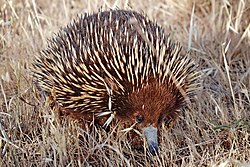


ハリモグラ


ハリモグラ属(Tachyglossus)は1属1種のみで、ハリモグラ(Tachyglossus aculeatus)が属している。


ハリモグラは頭胴長30~45cm、尾長 1cm、体重2.5~5kg。オスはメスより大きい。背面から側面にかけて、トゲが密生しており、これが最大の外見的特徴である。トゲは体毛が特殊化したものであり、長さは最大で50mm、基部は黄色、先端は黒色。トゲの間、また、体の下面や四肢は、黒色から淡褐色のやわらかい体毛に覆われている。


ハリモグラは、かたい土の上で敵に襲われたり、物音に驚いたりしたときは、体を丸め、栗のイガ状になることで身を守る。一方、地面がやわらかれば、素早く(条件に恵まれれば2-3分)土を掘り下げ、地面に垂直に沈んでいき、ついにはトゲだらけの背中しか見えなくなってしまう。「ハリモグラ」という和名に反して、基本的に地上生の動物だが、短いが力強い四肢と大きな爪をもち、穴を掘るのは非常に巧みである。岩の裂け目や丸太の穴の中にもぐりこみ、爪やケヅメで触れるものにしがみつくこともあるが、一旦こうなると、この動物を地上に引っ張り出すのは、非常に困難であるという[要出典]。


ハリモグラの細長い鼻面は、頭長の約半分を占め、毛はない。その先端にある口は、円筒形の舌を出し入れできるだけの幅(5mm)しか開かない。シロアリやアリをなめとる舌は、口先から最大で18cmも突き出すことができる。ハリモグラは基本的に単独で生活し、獲物の生息地の近くで暮らす。オーストラリア、タスマニアに広く分布し、ニューギニア島にも生息している。半砂漠から熱帯雨林まで、海抜 0m 地帯から高山地帯まで、さまざまな環境下に広く生息する。木に登ったり、走ったりすることもでき、ときには、川を渡る姿も見られる。普通は昼行性であるが、季節により薄明薄暮性や炎暑の季節には夜行性となる。岩の割れ目などで眠り、暑さを避けるために、体を地面に埋めて眠ることもある。雨も嫌いで、雨が降り続いていると、何日間でもじっとしている[要出典]。


オーストラリアでは、地域にもよるが冬にあたる6-9月が、ハリモグラの交尾期である。この時期になると、メスの腹部には育児嚢ができる。これは、腹部がくぼむと同時に、両側の皮膚と筋肉のひだが大きくなって形成されるものであり[要出典]、フクロネズミ目(有袋目)のものほど完全な袋状ではない。メスは約21-28日の妊娠期間ののち、仰向けの姿勢で、自分の育児嚢の中に卵を産む。産まれる卵は通常は1個だが、まれに2~3個のときもある。直径 14~17mm(ウズラの卵大)で、やわらかい殻に包まれている。卵は約10日で孵化し、生まれた子は、トゲが生えはじめるまで、そのまま育児嚢の中で生活する。母親は乳首をもたず、子は、育児嚢の前縁の近くにある乳腺からにじみ出るクリーム状の乳をなめて育つ。育児嚢を出た後も、約6か月間、子は母親から乳をもらい続け、生後約1年で独立して、母親のもとを離れていく。野生での寿命は最大で45年、飼育下では、最高49年が記録されている。


ミユビハリモグラ属


ミユビハリモグラの1種(Zaglossus bruijni)


ミユビハリモグラ属(Zaglossus)には、現生3種、絶滅2種が属す。


  • ニシミユビハリモグラ Zaglossus bruijni

  • ヒガシミユビハリモグラ Zaglossus bartoni

  • デビッドキョウミユビハリモグラ Zaglossus attenboroughi


  • Zaglossus hacketti †


  • Zaglossus robustus †

現生種 Zaglossus bruijni, Z. bartoni, Z. attenboroughi は、いずれもニューギニアに分布する。


頭胴長45~90cm、体重5~10kgと、ハリモグラより大きい。灰色から黒色のトゲをもつが、このトゲはハリモグラのものよりも短く、数も少ないので、褐色から黒色の体毛の下に隠れて、目にふれないことが多い。前後肢とも、3本の指の爪が発達している。山岳地帯の森林に住み、主食とするミミズのほかに、単独性の昆虫類も食べる。下方に湾曲した、きわめて細長い鼻面は、頭長の3分の2を占める。舌には、先端から口の奥に向かって、約3分の1のところまで、1本の溝があり、その中に角質の突起が生えている。この突起でミミズをひっかけると、ミミズは頭または尾から、舌の溝にそって、ちょうど蕎麦をすすりこむようにして、長い鼻面に取り込まれる。


ミユビハリモグラ属の現生種は、従来 Z. bruijni の1種のみとされていたが、最近になって Z. bartoni と Z. attenboroughi が分離されて、3種となった。なお、従来 Z. bartoni は Z. bruijni のシノニム(同種異名)であった。Z. attenboroughi (Sir David’s Long-beaked Echidna) はデイビッド・アッテンボローへの献名である。


ミユビハリモグラ属は、現生種のほかに2種の化石種が知られる。それらはかつて、オーストラリアとタスマニアの多くの地方に生息していたが、更新世後期までに絶滅した。現生のミユビハリモグラは、ニューギニアの高地にしか分布していない。しかしニシミユビハリモグラに関しては、1901年(明治34年)に西オーストラリア州キンバリー地域で捕獲された標本が存在することが、Kristofer M. Helgenらの研究で明らかになった。[2]化石種のうちで最も大きなものは、更新世に生息したジャイアントミユビハリモグラ Zaglossus hacketti で、頭胴長が約90cmあった。


ミユビハリモグラには、狭義のハリモグラに比べて飼育例が少ない。野外での生態についてもあまり知られていないが、だいたいのところはハリモグラに準ずるものと考えられる。野生での寿命も不明だが、ロンドンの動物園で、30年間飼育された例がある。生息の実態にも不明な点が多いが、現地では肉をとるために広く狩られており、存続が危ぶまれている。IUCNのレッドリストでは、EN(絶滅危惧種)に指定されている。


ハリモグラのキャラクター


  • NHK教育で放映された子ども向けアニメーション「はりもぐハーリー」の主人公はハリモグラ。

  • 現在、オーストラリアで流通している最低金額の通貨は5セント硬貨だが、その裏面には、丸くなったハリモグラが彫られている。


  • シドニーオリンピック(2000年)のマスコット・トリオの1人、ミリーもハリモグラ。オリンピック・マスコットとしては初の女性キャラクターでもあり、その名は「ミレニアム(千年紀)」に由来する。

  • ゲームの「ソニックシリーズ」にナックルズ・ザ・エキドゥナおよびティカルというハリモグラのキャラクターが登場している。


参考文献


  1. ^ BBC. “Short-beaked echidna, common echidna, spiny anteater”. 2010年5月9日閲覧。


  2. ^ http://www.pensoft.net/journals/zookeys/article/3774/twentieth-century-occurrence-of-the-long-beaked-echidna-zaglossus-bruijnii-in-the-kimberley-region-of-australia


  • the Department of Primary Industries, Parks, Water and Environment. “Short-beaked Echidna”. 2010年5月11日閲覧。

  • ANIMAL, David Burnie, Dorling Kindersley, 2006, ISBN 9781740335782

  • Egerton, L. ed. 2005. Encyclopedia of Australian wildlife. Reader's Digest ISBN 9780864491183

  • Cath Jones & Steve Parish, Field Guide to Australian Mammals, Steve Panish Publishing, 2004, ISBN 9781740217439

  • Peggy Rismiller, THE ECHIDONA, Hugh Lauter Levin Associates, 1999, ISBN 0-88363-788-X


関連項目


  • エキドナ:ギリシャ神話に登場する女怪。ハリモグラ類の英名である echidna はこれに由来。


「https://ja.wikipedia.org/w/index.php?title=ハリモグラ科&oldid=60114634」から取得


案内メニュー


(window.RLQ=window.RLQ||[]).push(function()mw.config.set("wgPageParseReport":"limitreport":"cputime":"0.328","walltime":"0.414","ppvisitednodes":"value":7100,"limit":1000000,"ppgeneratednodes":"value":0,"limit":1500000,"postexpandincludesize":"value":58363,"limit":2097152,"templateargumentsize":"value":25277,"limit":2097152,"expansiondepth":"value":22,"limit":40,"expensivefunctioncount":"value":1,"limit":500,"unstrip-depth":"value":0,"limit":20,"unstrip-size":"value":1041,"limit":5000000,"entityaccesscount":"value":1,"limit":400,"timingprofile":["100.00% 323.783 1 -total"," 41.29% 133.680 1 Template:生物分類表"," 15.99% 51.786 6 Template:要出典範囲"," 15.65% 50.685 7 Template:要出典"," 15.40% 49.861 2 Template:Taxonomist"," 14.36% 46.510 7 Template:Fix"," 14.09% 45.630 1 Template:AUY"," 13.27% 42.978 1 Template:Commons"," 13.23% 42.821 1 Template:AU"," 13.16% 42.625 2 Template:Sister"],"scribunto":"limitreport-timeusage":"value":"0.016","limit":"10.000","limitreport-memusage":"value":893019,"limit":52428800,"cachereport":"origin":"mw1326","timestamp":"20190317081049","ttl":2592000,"transientcontent":false););"@context":"https://schema.org","@type":"Article","name":"u30cfu30eau30e2u30b0u30e9u79d1","url":"https://ja.wikipedia.org/wiki/%E3%83%8F%E3%83%AA%E3%83%A2%E3%82%B0%E3%83%A9%E7%A7%91","sameAs":"http://www.wikidata.org/entity/Q21824","mainEntity":"http://www.wikidata.org/entity/Q21824","author":"@type":"Organization","name":"Contributors to Wikimedia projects","publisher":"@type":"Organization","name":"Wikimedia Foundation, Inc.","logo":"@type":"ImageObject","url":"https://www.wikimedia.org/static/images/wmf-hor-googpub.png","datePublished":"2004-06-09T16:50:17Z","dateModified":"2016-06-17T03:50:37Z","image":"https://upload.wikimedia.org/wikipedia/commons/2/20/Echidna.jpg"(window.RLQ=window.RLQ||[]).push(function()mw.config.set("wgBackendResponseTime":157,"wgHostname":"mw1253"););

Popular posts from this blog

Is it wise to focus on putting odd beats on left when playing double bass drums?What does the tie across other different notes mean?How to improve right hand picking/strumming technique for electric and acoustic guitar?How fast is the BPM should you start to use double bass pedal?Alternative or more advanced methods for counting rhythmsLost direction in practicing drumsIs there any way at all to tell if these measures are 6/4 vs. 3/2?Why is alberti bass so tiring?How does 'meter' differ from 'rhythm' in music?Rhythm question about piano sheet notationWhy is Bach's Cello Suite 1 written in 16th notes

map list to bin numbersquantilization (if that is a word)Map efficiently over duplicates in listGenerating a list of cubefree numbersIs there an equivalent to MATLAB's linspace?Convert a list of hexadecimal numbers to decimalTaking one list Mod a second listlist of items and group of alternative itemsHow find numbers in this list of inequalities?Selecting list entries with a True False index list of similar lengthReplace element in array by checking condition in another listAttempting to fill a table with the number of elements in each bin and make a table with the elements in the bins?

History of India Contents Prehistoric era (until c. 3300 BCE) Bronze Age – "First urbanisation" (c. 3300 – c. 1800 BCE) Climate change, de-urbanisation, and Indo-Aryan migrations (c.1800 – 1500 BCE) Iron Age - Vedic period (c. 1500 – c. 600 BCE) "Second urbanisation" (c. 600 – c. 200 BCE) Classical to early medieval periods (c. 200 BCE – c. 1200 CE) Late medieval period (c. 1200 – 1526 CE) Early modern period (c. 1526–1858 CE) Modern period and independence (after c. 1850 CE) Historiography See also References Further reading External links Navigation menureviewedee[update]The crisisThe Evolution and History of Human Populations in South Asia: Inter-disciplinary Studies in Archaeology, Biological Anthropology, Linguistics and GeneticsThe Ancient Indus: Urbanism, Economy, and Society"Indus River Valley Civilizations"The Ancient Indus: Urbanism, Economy, and Society"India before the British: The Mughal Empire and its Rivals, 1526–1857"Why Europe Grew Rich and Asia Did Not: Global Economic Divergence, 1600–1850Development Centre Studies The World Economy Historical Statistics: Historical StatisticsDeveloping cultures: case studiesEthnic Groups of South Asia and the Pacific: An Encyclopedia: An Encyclopedia"Indian Economy During British Rule""Economic Impact of the British Rule in India | Indian History"The Bone Readers: Science and Politics in Human Origins Research"Out of Africa: new hypotheses and evidence for the dispersal of Homo sapiens along the Indian Ocean rim"10.3109/0301446100363924920334598"Genetic and archaeological perspectives on the initial modern human colonization of southern Asia"2013PNAS..11010699M10.1073/pnas.1306043110369678523754394"Edakkal Caves|Places Around in Wayanad"Protecting megaliths to keep history alive The Hindu daily"Archaeologists rock solid behind Edakkal Cave"The Global Prehistory of Human Migration"Indus Valley 2,000 years older than thought"the original"Stepwells -Cosmology of Subterranean Architecture as seen in Adalaj"A History of Ancient and Early medieval India : from the Stone Age to the 12th century"Stone celts in Harappa"the original"Peoples and languages in pre-islamic Indus valley"the original"The Sindhi language"the originalThe Aryan chromosome"Fluvial landscapes of the Harappan Civilization"2012PNAS..109E1688G10.1073/pnas.1112743109338705422645375"Is River Ghaggar, Saraswati? Geochemical Constraints""An Ancient Civilization, Upended by Climate Change""Huge Ancient Civilization's Collapse Explained"2003GeoRL..30.1425S10.1029/2002GL0168222006QSRv...25.1283M10.1016/j.quascirev.2005.10.0122011QuInt.229..140M10.1016/j.quaint.2009.11.012Climate Change and the Course of Global History: A Rough JourneyA History of Ancient and Early Medieval India: From the Stone Age to the 12th CenturyA History of Ancient and Mediaeval India: From the Stone Age to the 12th CenturyAntennae SwordA History of IndiaA History of IndiaAn Introduction to Hinduism"India: The Late 2nd Millennium and the Reemergence of Urbanism"The Coinage of Ancient IndiaA Sanskrit reader: with vocabulary and notesPedigree: the origins of words from nature"Early Sanskritization. Origins and Development of the Kuru State"10.11588/ejvs.1995.4.823The Sanskrit epics, Part 2The City in South AsiaThe UpanishadsAn Introduction to HinduismReligions of the World, Second Edition: A Comprehensive Encyclopedia of Beliefs and PracticesA History of Ancient and Early Medieval India: From the Stone Age to the 12th CenturyEarly India: From the Origins to AD 1300Republics in ancient Indiapp. 83ff"Magadha Empire""Lumbini Development Trust: Restoring the Lumbini Garden"the originalThe great armies of antiquityarchived"The Achaemenid Persian Empire (550–330 B.C.)""East–West Orientation of Historical Empires"1076-156X"Dinner on the Grand Trunk Road"10.2307/32502263250226"Silappathikaram Tamil Literature"the originalManimekalai – English transliteration of Tamil originalIndian Temple Architecture: Form and Transformation : the Karṇāṭa Drāviḍa Tradition, 7th to 13th CenturiesBuddhist ArchitectureA History of India"The World Economy (GDP) : Historical Statistics by Professor Angus Maddison"The World Economy – Volume 1: A Millennial Perspective and Volume 2: Historical Statistics10.2307/32502140004-36483250214A Comprehensive History of India: Volume 2Between the Empires: Society in India, 300 to 400Emergence of Viṣṇu and Śiva Images in India: Numismatic and Sculptural Evidence"Parthian Pair of Earrings"the originalThe Medical Times and Gazette, Volume 1Greatest emporium in the worldThe Cambridge History of Ancient China: From the Origins of Civilization to 221 BCBuddhist Records of the Western WorldArchaeology in Soviet Central AsiaThe Grandeur of Gandhara: The Ancient Buddhist Civilization of the Swat, Peshawar, Kabul and Indus ValleysIndian Sculpture: Circa 500 B.C.-A.D. 700"The History of Pakistan: The Kushans"Gupta Dynasty – MSN Encartathe original"India – Historical Setting – The Classical Age – Gupta and Harsha""Gupta Dynasty, Golden Age Of India"the original"The Age of the Guptas and After"the originalNumber Theory and Its History"Gupta dynasty (Indian dynasty)""Gupta dynasty: empire in 4th century"the original"The Story of India – Photo Gallery"The ASI say499315420"Pallava script"p. 145"CNG: eAuction 329. INDIA, Post-Gupta (Ganges Valley). Vardhanas of Thanesar and Kanauj. Harshavardhana. Circa AD 606–647. AR Drachm (13mm, 2.28 g, 1h)""Harsha""Sthanvishvara (historical region, India)""Harsha (Indian emperor)"Shyama Kumar Chattopadhyaya (2000) The Philosophy of Sankar's Advaita VedantaShankara's IntroductionShankara's Introduction19373677Shankara's IntroductionIs The Buddhist 'No-Self' Doctrine Compatible With Pursuing Nirvana?The Seven Spiritual Laws Of YogaIndia: The Ancient Past. A History of the Indian-Subcontinent from 7000 BC to AD 1200The Kashmir Series: Glimpses of Kashmiri Culture – Vivekananda Kendra, Kanyakumari (p. 57).Al-Hind: Early Medieval India and the Expansion of Islam, 7th–11th CenturiesHistory of GopāchalaLand of Two Rivers: A History of Bengal from the Mahabharata to MujibEuropean Trade and Colonial ConquestA History of IndiaA Comprehensive History Of Ancient India (3 Vol. Set)"The Last Years of Cholas: The decline and fall of a dynasty"the originalFascinating Hindutva: Saffron Politics and Dalit MobilisationGazetteer of the province of OudhAl- Hind: The slave kings and the Islamic conquest. 2"Shahi Family"The Cambridge history of Islam"Ameer Nasir-ood-deen Subooktugeen"Gazetteer of the Attock District, 1930, Part 1Land of seven rivers: History of India's GeographyTemple Desecration and Indo-Muslim StatesIslam in South Asia: A Short HistoryBeyond Orientalism: The Work of Wilhelm Halbfass and Its Impact on Indian and Cross-cultural StudiesThe Making of Terrorism in Pakistan: Historical and Social Roots of ExtremismOrnament in Indian ArchitectureA historical review of Hindu India: 300 B.C. to 1200 A.D."Indian States and Union Territories"Islam in South Asia: A Short HistoryA Brief History of the Indian PeoplesThe Modern ReviewDelhi Sultanate"Battuta's Travels: Delhi, capital of Muslim India"the original"Timur – conquest of India"the originalIndia HandbookBhaktiThe Four Denomination of Hinduism10.1007/s11407-008-9049-925691067"Vijayanagara Research Project::Elephant Stables"10.2307/26465262646526Historical Dictionary of the TamilsBihar General Knowledge DigestMapping Bihar: From Medieval to Modern TimesPopular Literature and Pre-modern Societies in South AsiaA manual of the Kistna district in the presidency of MadrasAncient Indian History and CivilizationFragmented Memories: Struggling to be Tai-Ahom in India"The Islamic World to 1600: Rise of the Great Islamic Empires (The Mughal Empire)"the originalDynasties: A Global History of Power, 1300–1800, p. 105"Whose fort is it anyway"10.1111/0020-8833.000532600793Development Centre Studies The World Economy Historical Statistics: Historical Statistics"India's Deindustrialization in the 18th and 19th Centuries"The Mughal Empire, p. 190"The Long Globalization and Textile Producers in India"The Mughal World: Life in India's Last Golden AgeAurangzeb: The Life and Legacy of India's Most Controversial KingIn the Shadow of the Taj: A Portrait of Agra"Iran in the Age of the Raj"p. 8610.2307/20539802053980Delhi, the Capital of IndiaAn Advanced History of Modern India"Journal of the Tanjore Maharaja Serfoji's Sarasvati Mahal Library"The Rediscovery of India: A New SubcontinentIslamic Renaissance In South Asia (1707–1867) : The Role Of Shah Waliallah & His SuccessorsAn Advanced History of Modern IndiaThe Great Maratha Mahadaji Scindia"Full text of "Selections from the papers of Lord Metcalfe; late governor-general of India, governor of Jamaica, and governor-general of Canada""The Discovery Of IndiaThe Sacred City of the Hindus: An Account of Benares in Ancient and Modern TimesResurrecting Banaras: Urban Space, Architecture and Religious BoundariesFaith & Philosophy of Sikhism"Missiles mainstay of Pak's N-arsenal"History Modern India By S.N. Sen"Sirajuddaula"ArchivedLongman History & Civics (Dual Government in Bengal)Madhya Pradesh National Means-Cum-Merit Scholarship Exam (Warren Hasting's system of Dual Government)A Military History of Britain: from 1775 to the PresentIndian Cultural Heritage Perspective For TourismHindu Rulers, Muslim Subjects: Islam, Rights, and the History of KashmirIndian HistoryAn Atlas and Survey of South Asian HistoryAn Historical Account of the British Trade Over the Caspian SeaIndian Merchants and Eurasian Trade, 1600–1750The Indian diaspora in Central Asia and its trade, 1550–1900From Constantinople to the home of Omar Khayyam: travels in Transcaucasia and northern Persia for historic and literary researchA journey from Bengal to England: through the northern part of India, Kashmire, Afghanistan, and Persia, and into Russia, by the Caspian-SeaA Second Journey through Persia, Armenia, and Asia Minor, to Constantinople, between the Years 1810 and 1816Reports from the consuls of the United States, 1887Portugal and its Empire, 1250–1800 (Collected Essays in Memory of Glenn J. Ames).: Portuguese Studies Review, Vol. 17, No. 1The Dutch Power in Kerala, 1729–1758http://mod.nic.inArchivedDossier Goa – A Recusa do Sacrifício InútilAn Imperial Crisis in British India: The Manipur Uprising of 1891The Truth of Babri Mosque"Kolkata (Calcutta) : History"the original"Robert Clive, Baron Clive, 'Clive of India', 1725–1774""The Transformation from a Pre-Colonial to a Colonial Order: The Case of India"10.2307/25955872595587A versatile geniusArchived10.1109/MWSYM.1997.602854"Rabindranath Tagore on Education"the original"Essay on 'Derozio and the Young Bengal Movement'"Poverty and Famines: An Essay on Entitlement and Deprivation"Plague"the originalPopulation Growth and Land Use"Reintegrating India with the World Economy""Census Of India 1931"A history of modern India, 1480–1950"'India's well-timed diversification of army helped democracy' | Business Standard News"Bal Gangadhar Tilak: Struggle for Swaraj"Participants from the Indian subcontinent in the First World War""Commonwealth War Graves Commission Annual Report 2007–2008 Online"the original1462689197110.1017/s0010417500016534178920Eurocentrism: a marxian critical realist critique"Ranjit Guha, "On Some Aspects of Historiography of Colonial India""10.2307/2168385216838510.7202/016593ar"Harvard scholar says the idea of India dates to a much earlier time than the British or the Mughals""In The Footsteps of Pilgrims""India's spiritual landscape: The heavens and the earth""India: A Sacred Geography by Diana L Eck – review"Modern India: The Origins of an Asian Democracy10.2307/21694222169422964322464"The Indian Subcontinent and 'Out of Africa 1'"254043308Encyclopedia of World ReligionsThe Evolution and History of Human Populations in South Asia: Inter-disciplinary Studies in Archaeology, Biological Anthropology, Linguistics and Genetics"The Early Paleolithic of the Indian Subcontinent: Hominin Colonization, Dispersals and Occupation History"Ancient Indian History and CivilizationAncient Indian Social History: Some Interpretationsthe originalIndia Before EuropeA Concise History of Modern India"The beginning of the historical period, c. 500–150 BCE"full textA History of Indiathe originalexcerpt and text searchexcerptexcerptAn Economic History of India: From Pre-Colonial Times to 1991excerpt and text searchexcerpt and text searchIndia as known to the ancient world10.1111/j.1468-0289.1985.tb00391.x2597191onlineThe History of India, as told by its own historians. The Muhammadan Periodonline editionHans William Brown research collection on 19th-century missionary work in India, 1882–1932, Ms. Coll. 1033, Kislak Center for Special Collections, Rare Books and Manuscripts, University of Pennsylvaniaee